Audience Library
Concept | Last updated: 5/8/2026 | Learn about the Audience Library
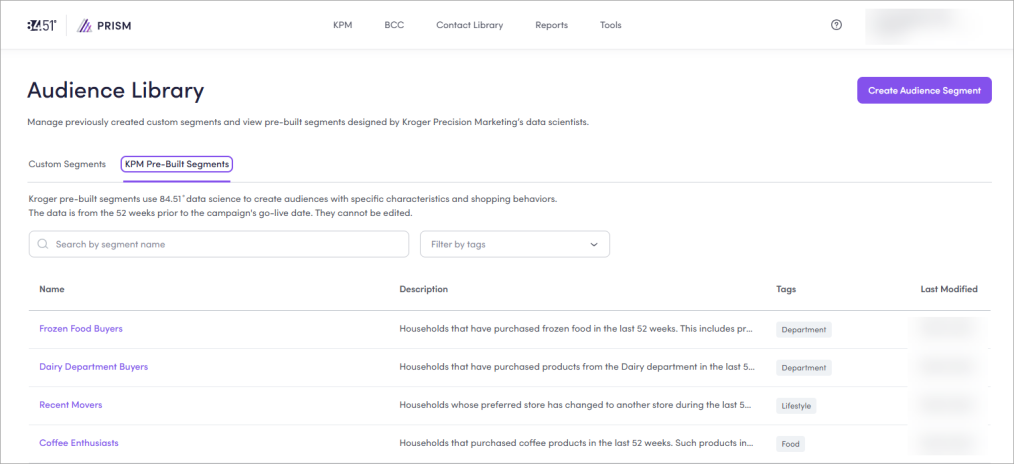
The Audience Library is a collection of Audience Segments that include your Custom Segments and KPM Kroger Precision Marketing Pre-Built Segments.
These Audience Segments are a subset of an audience, which include items (like UPCs Universal Product Codes or Commodities), dates, and shopper buying patterns.
In the Audience Library, you can:
-
Create Audience Segments agnostic of a Campaign.
-
Leverage 84.51° data science with the KPM Pre-Built Segments.
-
Save and re-use Audience Segments across Campaigns.
Custom Segments
Custom Segments are the Audience Segments that you create. These segments in the Audience Library act as templates and become independent instances once added to a Campaign.
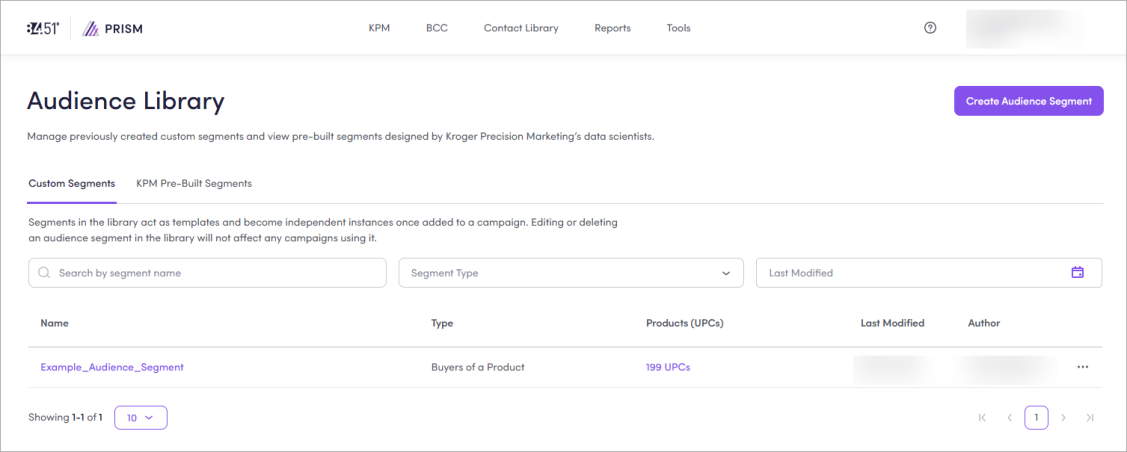
You can search for these Audience Segments by name, type, or date modified and editing or deleting Audience Segments in the Audience Library will not affect any Campaigns using them.
Custom Segment types
In 84.51° Prism, there are eight (8) Custom Segment types that you use to define Audience Segmentss for your Managed Service and/or Incentives Campaigns.
|
Segment type |
Description |
Recommended use cases |
|---|---|---|
|
Brand Switchers |
|
|
|
Buyers of X |
|
|
|
Heavy / Medium / Light Buyers |
|
|
|
New or Lapsed Buyers |
|
|
|
Predefined Segmentations |
Purchasing behavior defined by 84.51° data science that can be customized for a given segment. |
|
|
Previous Redeemers / |
Previously downloaded or redeemed coupons (like Targeted Digital Coupons and General Coupon Pool) Offers. |
|
In 84.51° Prism, you can create Audience Segments defined by their shopping behaviors and/or attributes to:
-
Acquire new households Households that have not bought the promoted product in the latest 52 weeks.
-
Grow share with existing shoppers.
-
Reward loyal shoppers.
To learn how to use these, see Use Audience Segments.
Mutual Exclusivity
Custom Segments are mutually exclusive meaning that a Kroger household can only fall into one (1) created segment. For example, a household could be classified as both Buyers of Kroger Coffee as well as Coffee Category Buyers.
However, based on the priority of the Audience Segments, the household is evaluated for each segment in priority order. Once they are captured in one (1) segment, they cannot be counted in any other segment.
So, for this example, if the top priority is Kroger coffee buyers, then the household would fall into the Buyers of Kroger Coffee segment (targeting only Kroger Coffee UPCs).
To learn more, see Use Audience Segments.
KPM Pre-Built Segments
KPM Pre-Built Segments are the Audience Segments that use 84.51° data science to create audiences with specific characteristics and shopping behaviors.
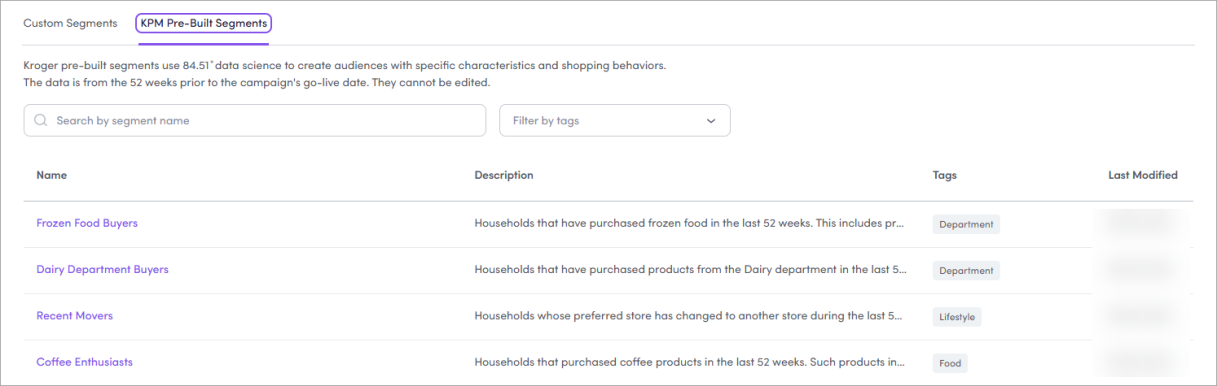
You can search for these segments by name or tag (like Behavioral, Cultural, or Demographic).
Data for these Kroger audiences is collected from the 52 weeks prior to the Campaign's go-live date.
KPM Pre-Built Segments cannot be edited or deleted.
KPM Pre-Built Segment types
In 84.51° Prism, there are many KPM Pre-Built Segments that also leverage 84.51° data science with predefined audience characteristics and shopping behaviors. These Audience Segments range anywhere from Arts & Crafts Enthusiasts to Veggie - Focused Food Buyers, so you're sure to find the right segment type for your Managed Service, Direct Connect, and/or Incentives Campaigns.
To learn how to use these, see Use Audience Segments.
Audience optimization
84.51°'s personalization science ranks every coupon offer and scores every Kroger household to create a personalized ranking of offer preference. 84.51° continues to research and continuously improve how to best optimize across households, offers, and channels to drive loyalty in an evolving retail landscape.
How 84.51° Prism identifies customers
Targeting is a marketing strategy that involves sorting potential customers into groups based on shared characteristics to create personalized marketing messages that reach the right people at the right time. Defining your target audience starts with the product itself. You should carefully consider how the product(s) meet customer needs and delivers personal benefits. There might even be more than one type of demographic or interest category that you can cater to with the same product(s).
Some benefits of targeting include helping you:
-
Generate more high-quality leads.
-
Increase web traffic.
-
Earn a higher ROI Return on Investment.
These "right people at the right time" are the target audience — the specific group of consumers most likely to buy or be interested in your products or services. These audiences can consist of broad and mostly generic variations (like age, gender, or location) or very unique combinations of audience factors. Finding these factors will let you define the ideal blend of characteristics and human interests that you can use for your target audience marketing.
Knowing your target audience is extremely important for effective marketing. The way you reach different audiences changes based on their behaviors and preferences, so you should be ready to redefine your marketing and unique value proposition as needed.
For example, if you’re trying to target a young audience, you’re more likely to reach them via social media rather than a print advertisement in the newspaper. Additionally, you may use different images when trying to reach a family versus a young professional. If you’re targeting families, you may create an ad that shows other families using your products. For the young professional, you may show a young person in their apartment benefiting from your product.
Research has shown that mass coupons don’t boost sales or build loyalty as shoppers really want to have a personalized customer experience. Today, shoppers expect to:
-
Be recognized by name.
-
Have their preferences remembered.
-
Receive product recommendations and content that is relevant to them.
Therefore, companies and brands that understand their customers and respond accordingly can significantly improve the customer experience, create consistency across channels, increase loyalty, and drive more revenue.
84.51° Prism helps find households to reward with these coupons and offers using a mathematical model to calculate a relevancy score for every customer representing the likelihood the household will redeem the offer and how relevant the offer is for the household.
The model consists of targeting and allocation processes designed to prevent bias and create an accurate prediction.
Gather eligible households
-
Identify eligible households based on the channel (like Display Ad or Meta Ad)
-
Filter eligible households based on division penetration for selected UPCs
Analyze shopper attributes and behaviors
-
Include behavioral information about the household and how they engage across the store
-
Look at product and household attributes like Quality, Convenience, and Price dimensions
Once these customers / households are identified, allocation process begins.
How 84.51° Prism delivers more effective campaigns
Household level coupon scoring drives allocation. How these offers are allocated to each household depends on various factors like recent brand purchases and spend, and the number of visits to category to calculate a relevancy score. This relevancy score is the likelihood of a specific customer redeeming a specific offer.
Score and rank households
-
Apply advanced machine learning techniques to predict a household's response to the Campaign based on the data
-
Rank households based on predicted response (score) and historical Campaign results
-
Remove ineligible household offers (for example, any forbidden by state law, multiple purchase requirements, or sensitive products) and rank eligible household offers.
-
Consider the (1) best offer for each nomination, (2) for each household, and (3) for the event as a whole
-
Select the highest scores within each nomination
-
Select the highest scores within each household
-
Select the highest scores overall
-
Once you've made these considerations, you can begin to allocate offers to as many households as possible. Each household is allocated the most relevant coupon available. However, every household cannot get their highest scoring offers due to a number of factors, including, but not limited to:
-
Limited offer inventory
-
Mutual exclusions (to ensure product category variety)
-
Product and brand overlap exclusions (to ensure brand variety)
There are many other variables that influence your allocations like:
|
|
Select and recommend households
-
Based on the budget and campaign initiative, 84.51° Prism selects the households that are the most optimal for the Campaign
-
Awareness — Identifies the households most relevant to your brands; drive more attributable sales and increase impressions
-
Consideration — Identifies the households most likely to engage with your brands; avoid media waste and reduce the cost of acquisition
-
Conversion — Identifies the households most likely to engage with your brands over another; remove the guess work and improve upon iROAS Incremental Return on Ad Spend
-
84.51° Prism generates a recommendation that shows the household mix selected and estimated redemption costs (where applicable)
84.51° Prism finds the right mix of households to produce an optimized recommendation to maximize performance. By pairing your Campaign initiative, timing, and budget with 84.51°'s extensive data and science, you can understand what motivates a customer to change their behavior and optimize your Campaign.
Related topics
Want to learn more about this topic? See these related topics:
Learn more
Explore other sections in the Learning Center to learn more about 84.51° Prism:
 Go to
Go to